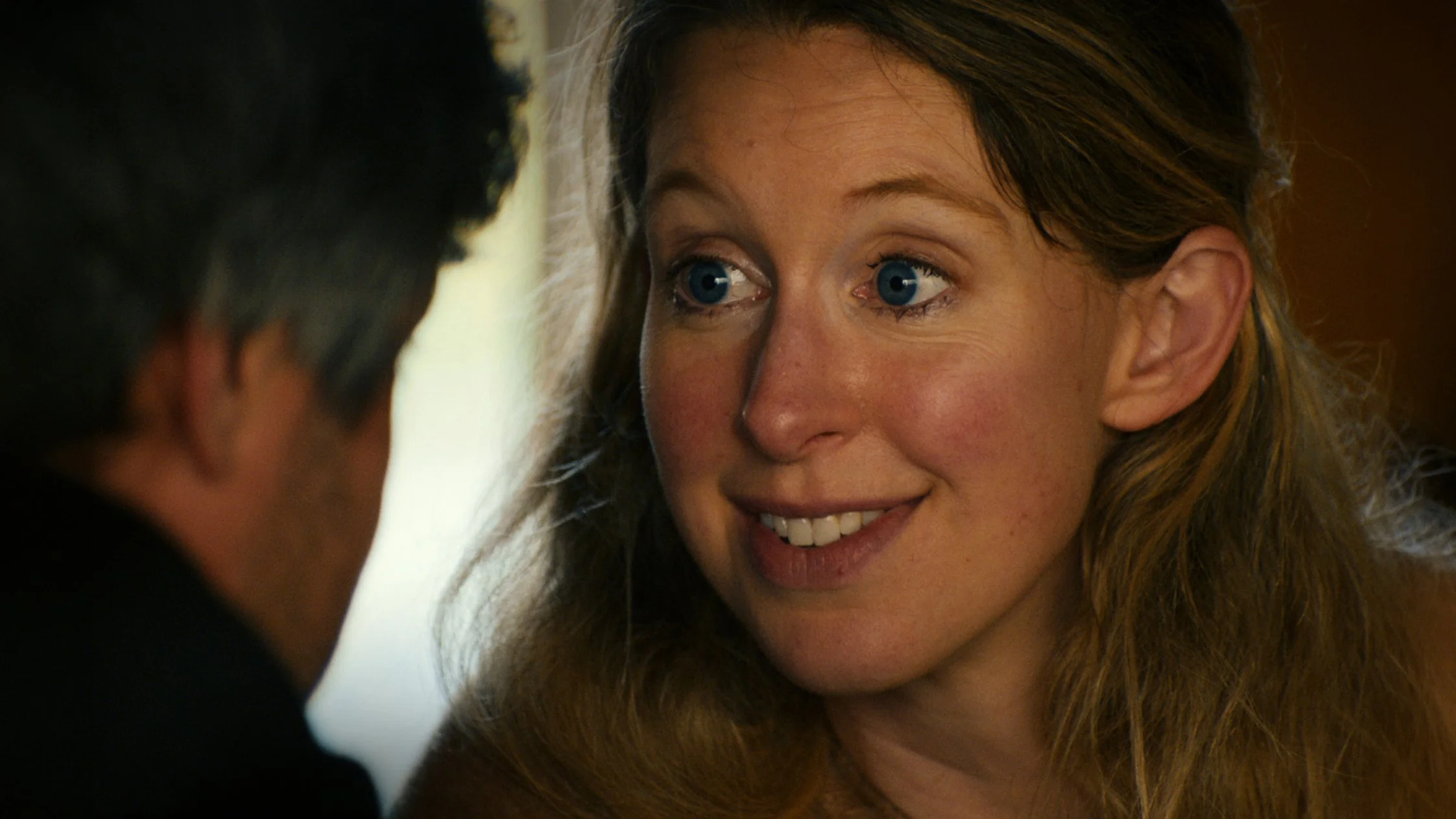
Extreme Close-up: Nathan Fielder and Elizabeth Holmes stare each other down in the mind-blowing You Can See Everything. Pic: A24
Radical Transparency - You Can See Everything review
A version of this appeared in The Scotsman in November 2026.
“Radical transparency” promises Elizabeth Holmes’ romantic partner Billy Evans in the opening scene of You Can See Everything, Nathan Fielder’s wild documentary about the scandal-plagued Theranos entrepreneur. Radical transparency, however, is not exactly what we get as Fielder embeds himself with Holmes in the weeks before she begins her prison sentence for defrauding investors over the viability of her company’s supposedly revolutionary ability to perform all manner of medical tests from a single drop of blood.
The story of Theranos—which Holmes set up at 19 with her then partner Sunny Balwani and which attracted the support of a whole coterie of geriatric powerbrokers like George Shultz and Henry Kissinger—has been told multiple times already, but never quite like this. Over the course of three crazily compelling hours, what comes on as very intimate, in-your-face documentary portrait (the extreme close-up is this film’s signature shot) gradually reveals itself to be more of an absurdist art installation-style intervention, one that slyly simulates the world that allowed Holmes—at one time billed as the next Steve Jobs and the youngest self-made female billionaire in history— to thrive in the fake-it-till-you-make start-up culture of Silicon Valley in the early 2000s.
Fielder’s subjects are certainly slippery in the extreme. Watching both the unrepentant Holmes (who claims on camera she’s never told a lie in her adult life) and the controlling and increasingly unhinged-seeming Evans (“I have vengeance in my heart” he confesses late on, comically unaware that he sounds like a playground bully version of a Bond villain), it’s hard to tell if they’re delusional or calculating, genuine or performative. As they tie themselves in linguistic knots deflecting Fielder’s questions, it’s like watching characters in a crime movie trying to beat a polygraph, though at least part of the intrigue is trying to figure out if Holmes has deceived herself so much she’s become a victim of her own reality distortion field, leaving her broken-brained and fully convinced of her own truth.
That’s a phrase she bandies around a lot, egged on by Evans, the heir to a hotel fortune who’s eight years her junior and whose own relationship with the truth seem similarly fluid, starting with his claim that he didn’t know who Holmes was when they first met in the immediate aftermath of the Theranos implosion. This despite working in Silicon Valley and once visiting her old office building.
But Holmes and Evans have also met their match in the deadpan Fielder, whose conceptually ambitious, Synecdoche, New York-esque HBO show The Rehearsal laid some of the groundwork for what transpires here, particularly in the second half of the film when his access to Holmes is suddenly curtailed by her incarceration. Co-directing with Lance Oppenheim (who made the recent Robert Pattinson film Primetime), Fielder inserts himself into the action early on, becoming an intrusive, awkward presence and eventually taking them up on their offer to move in with them and their young children in their San Diego beach-front property.
For the couple—who we see are in the process of trying to launch Theranos 2.0 —Fielder’s film is a chance for them to change the narrative. They seem particularly aggrieved by a recent New York Times interview in which they claim Elizabeth has been misquoted regarding her feelings about the way she’s been portrayed in public; sensing an opportunity, Fielder keeps pulling on this thread to try and unravel whether or not she’s actually — as the Times article claims — playing a character she invented.
But they’re aggrieved too by the extent to which public perception has been shaped by the Amanda Seyfried-starring TV drama The Dropout, hitherto the most high-profile entry into the cottage industry of Elizabeth Holmes-centric pop-culture content that has sprung up since the collapse of Theranos in 2016, among them books, podcasts, memes and documentaries. In one of the film’s biggest coups, Fielder even persuades them to watch The Dropout on camera, giving the show a jaw-dropping second life in ways that would be remiss to spoil in a review.
But if it seems baffling they would allow Fielder this much access given their past media experiences, the decision is more revealing than it at first appears. Though it’s entirely possible she may have thought Fielder would simply burnish the Elizabeth Holmes myth in same the way that Oscar-winning documentary maker Errol Morris did when he directed an advertising campaign for Theranos back in 2015, it’s also evident she doesn’t quite get that Fielder is primarily a comedian whose chosen platform happens to be documentaries. At one point he even asks her she thinks it’s strange they picked him to do this project given he’d previously made a TV Show—Nathan for You—about scam businesses.
Can she really be this naive? Maybe, maybe not. What is clear is that Evans—who has various ulterior motives for embarking on the project—has significantly underestimated Fielder, perhaps because, like Elizabeth, Fielder comes off as awkward and socially inept and, judging from the way Evans exerts control over the mother of his children (starting with the way she whisks eggs), maybe he thinks these sorts of traits make Fielder pliable enough to do their bidding.
What’s fascinating, though, is Fielder’s willingness to play along, to be a useful idiot in order to expose something bigger. Which isn’t to say he doesn’t challenge them or hold them to account. He does, frequently and thrillingly, at one point capturing an unguarded moment of off-camera conversation that seems to confirm their deceptive intent; at another holding Elizabeth’s unblinking gaze in a Larry David-style stare-down, his own bullshit meter working overtime.
But he also leaves plenty of threads purposely un-pulled, blithely skipping past bombshell statements, turning off his own mic at key moments, and forcing us to rely on his own (possibly unreliable) recollections of how certain interactions have played out off camera. When he finds his own view of Elizabeth softening, it can even feel frustrating, a betrayal of the car-crash spectacle we’ve been promised by all the expertly veiled, pre-release hype.
And then the audacious second half kicks in. Beginning with a jaw-dropping and hilarious twist and continuing with playfully subtle (then not so subtle) nods to Vertigo, Hitchcock’s classic tale of obsession and deception, Fielder and Oppenheim start refining the techniques of The Rehearsal as the reconfigure everything we’ve been watching so it corresponds to key aspects in the Theranos story, allowing us, in effect, to see how things might have played out behind closed doors and showing us how history has habit of repeating itself. It’s an extraordinary feat of filmmaking chutzpah, one that shatters the faux authenticity of the documentary format to get at something more truthful about our corrupt, untrustworthy times.