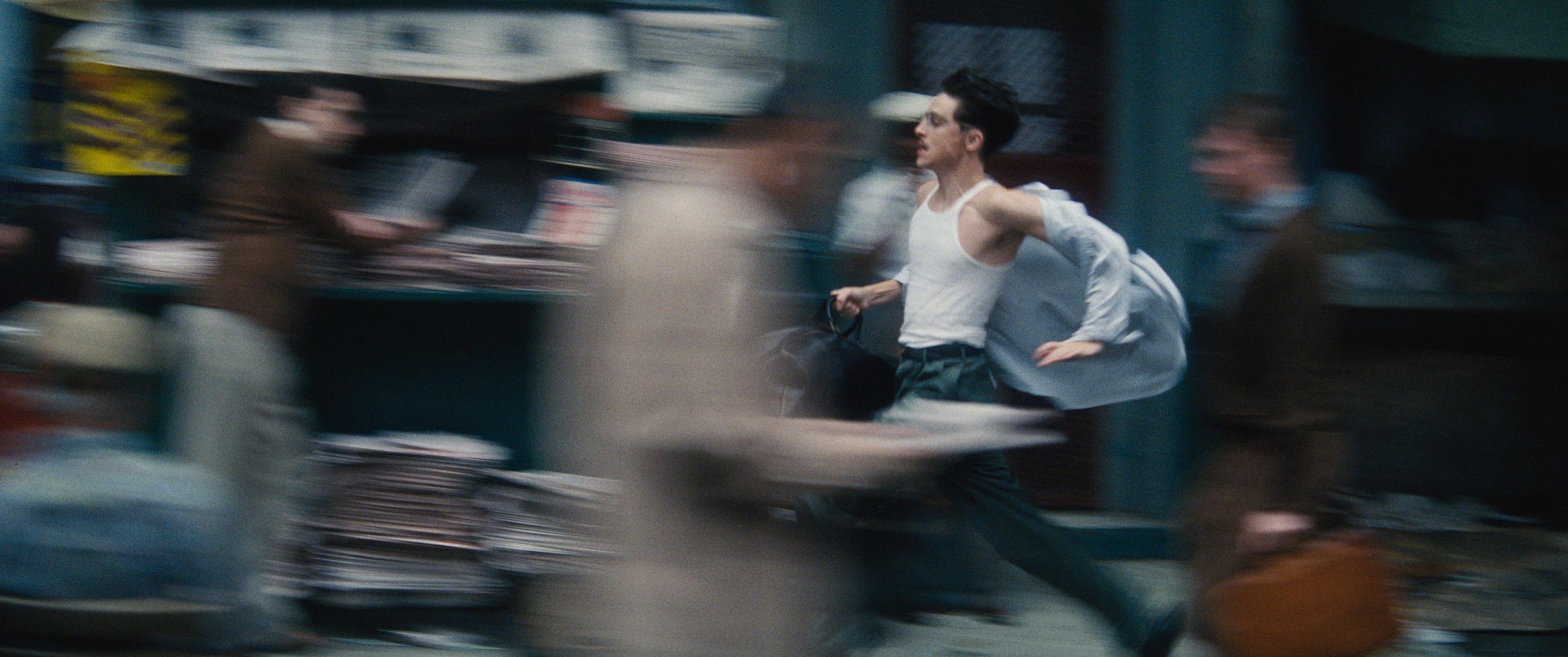
Motion blur: Timothée Chalamet. Pic: A24
Feel Bad - Marty Supreme review
A version of this appeared in The Scotsman in December 2025.
Marty Supreme sees co-writer/director Josh Safdie follow brother and frequent collaborator Bennie Safdie’s recent film The Smashing Machine with a sports movie of his own—only this erratic tale of an American ping pong prodigy trying to bring table tennis to prominence in the 1950s is only nominally about the sport. Really it’s a chaotic character study of a young narcissistic hustler whose pull-yourself-up-by-the-bootstraps dynamism exposes the ruthlessness of American individualism. Played by Timothée Chalamet, the film’s protagonist, Marty Mauser, is like an evil twin of Walter Mitty, a dreamer whose scams and delusions in pursuit of greatness leave a trail of emotional and physical devastation in their wake, something Safdie—echoing the panic-attack anxiety of his last film Uncut Gems —orchestrates with the furious pace of a table tennis match.
No sooner are we introduced to Marty working in his uncle’s shoe store, we see him impregnate—and abandon—his oldest friend (the excellent Odessa A’Zion), rob his co-worker, fly to London, inveigle his way into a room in the Ritz, seduce a faded movie star (Gwyneth Paltrow), scandalise the press, and participate in an international table tennis competition, where he loses the final in disgraceful fashion to the Japanese champion. The rest of the film is devoted to his determination to travel to Japan for a spectacular rematch, but his refusal to do anything on anyone’s terms but his own starts bringing his tenuously constructed world down around him—literally in the case of one set-piece featuring a dog-loving gangster, played by Bad Lieutenant’s gonzo director Abel Ferrara.
It’s a dizzying piece of filmmaking and Chalamet’s whiplash-inducing performance is one of the best things he’s done. Like the novelty orange ping-pong balls Marty prematurely manufactures with his titular nickname emblazoned across them, the character is made in the USA and full of air, a hollow advertisement for himself, and Chalamet—wispy frame, wispier moustache—nails his sociopathic, desperate drive for success, right down to the crocodile tears that flow in the film’s faux redemptive ending, which feels as deliberately disconnected from what we’ve just watched as its anachronistic 1980s’ pop soundtrack is from the film’s grotty 1950s’ period design. It’s a feel-bad movie for feel-bad times.